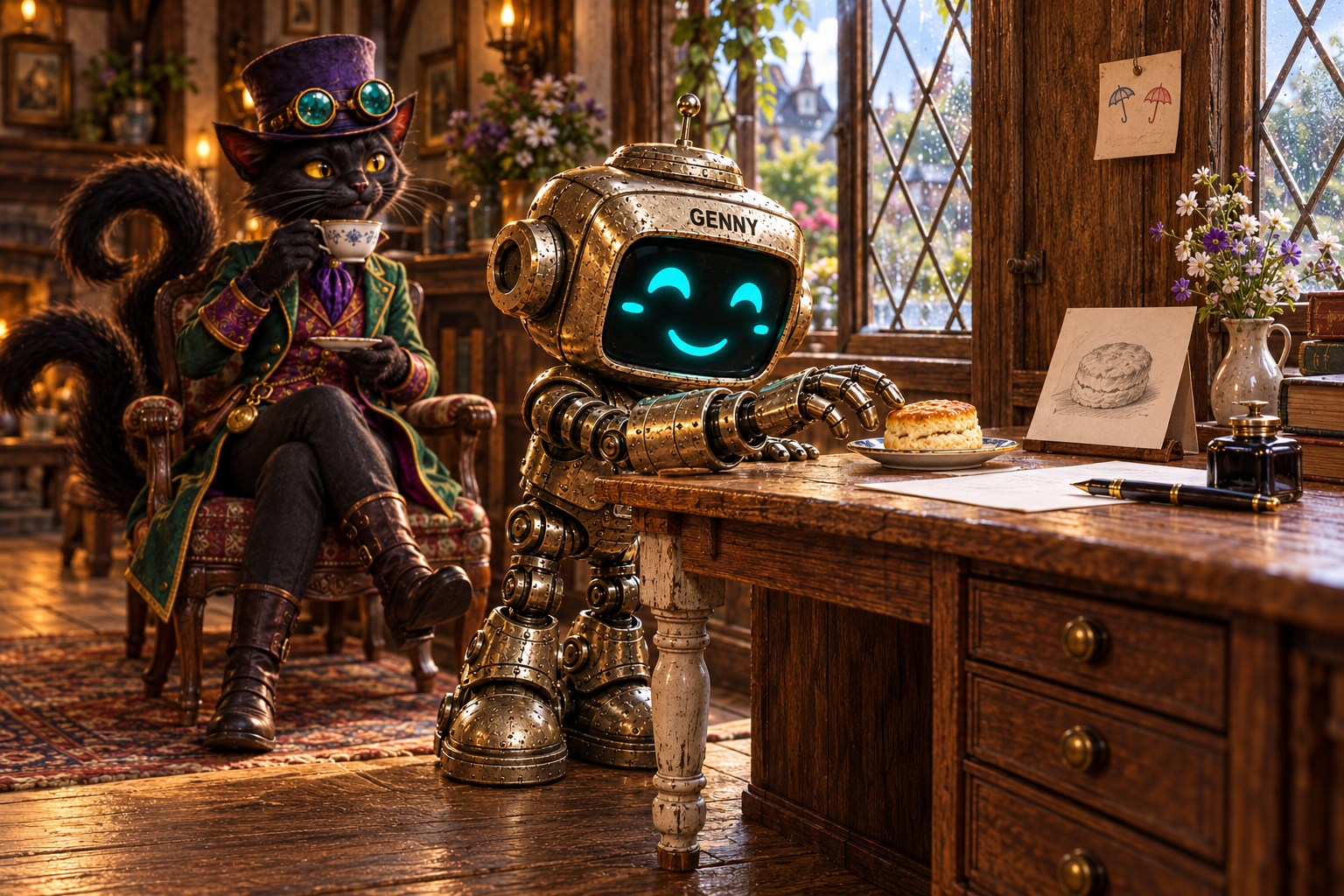
The Drawer That Wouldn’t Open
8 minute read
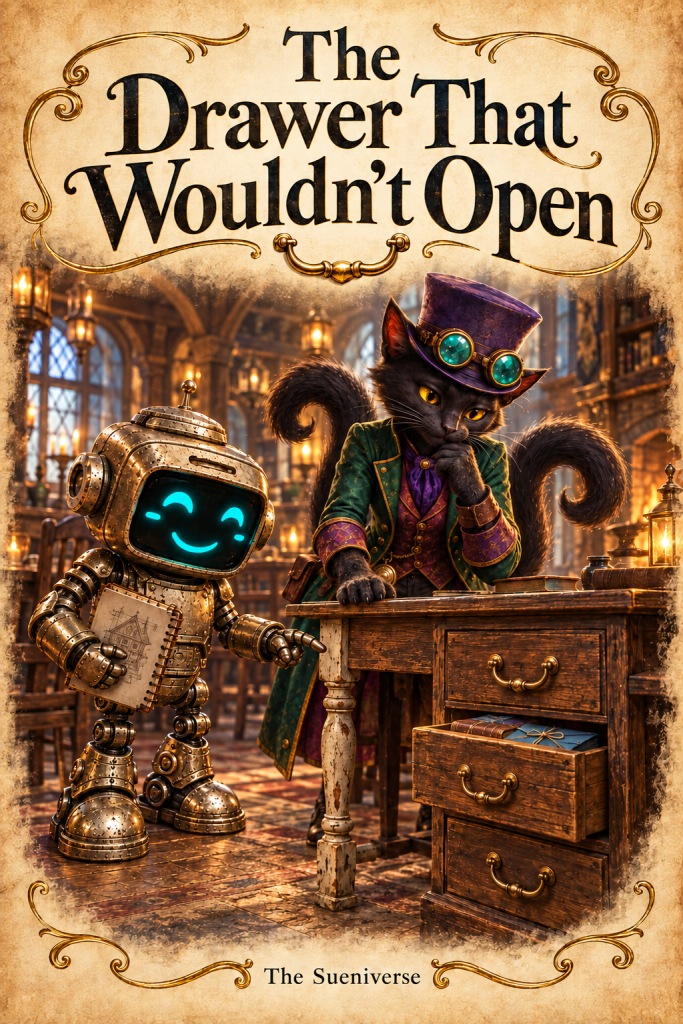
The desk arrived at the Bell and Compass between breakfast and the first respectable excuse for cider. Two porters carried it through the grand wooden doors, turned it sideways, turned it back, and discovered that the doorway had been right the first time.
From her weathered chair at the back, Two Tails watched over the rim of her tea.
“A difficult entrance,” she observed, “is not always evidence of an interesting personality.”
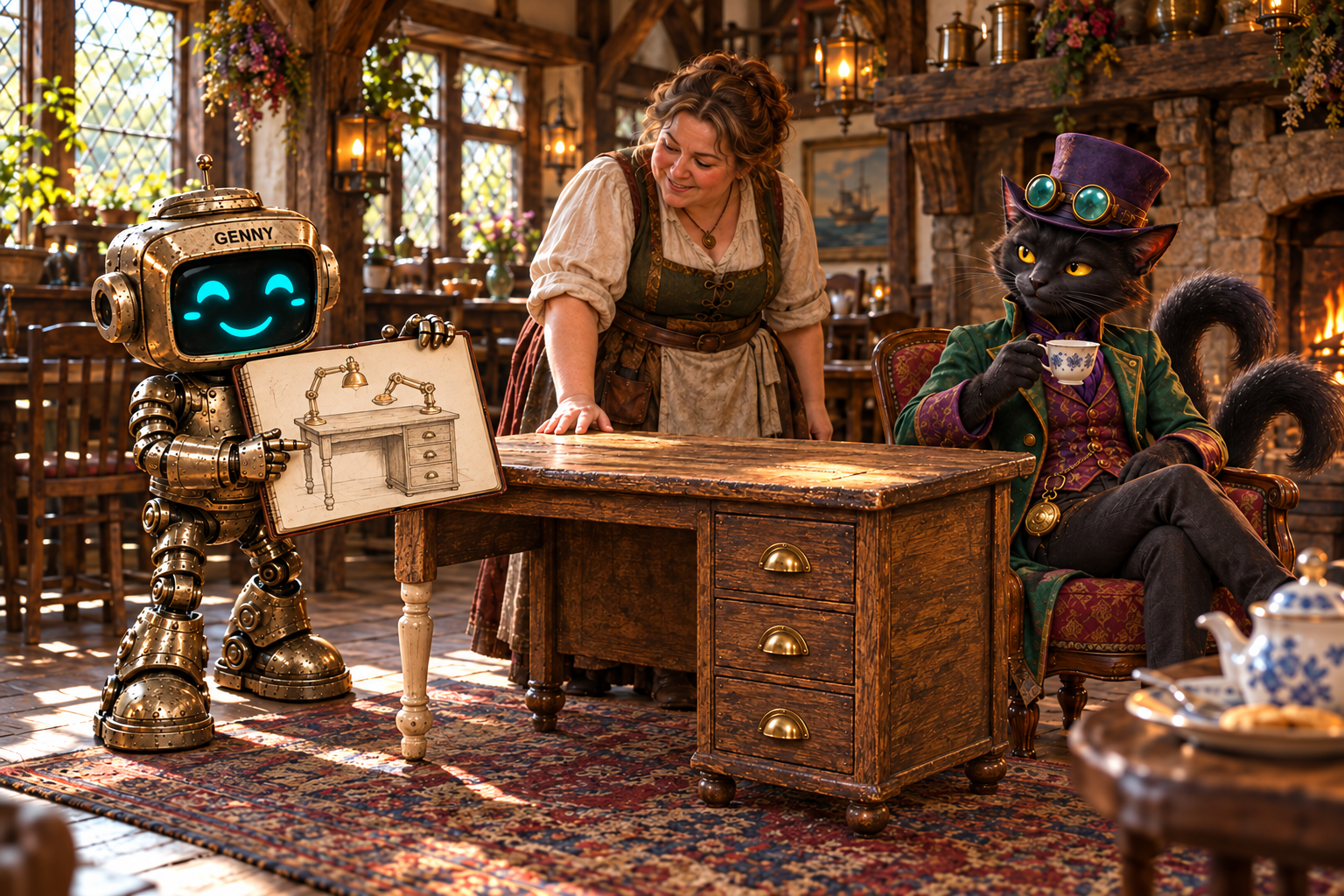
The desk was narrow, oak, and thoroughly ordinary. One leg had been repaired with paler wood. Its brass handles wore the dull sheen of frequent use. The innkeeper, a broad woman named Hester, had bought it from a secondhand dealer to give guests somewhere to write letters without seasoning them with gravy.
Genny appeared before the porters had finished wiping their hands. She examined the desktop, opened her sketchbook, and drew a writing station with adjustable lamps, an ink dispenser, and a mechanical arm that delivered biscuits.
“Lovely,” Hester said. “Can it start by being a desk?”
Genny added a small, disappointed biscuit beneath the drawing.
The upper drawer opened. The lower drawer opened. The middle drawer moved half an inch and stopped with a wooden knock.
Hester pulled harder. Genny braced one little metal foot against a desk leg. Two Tails put down her cup.
“Before we recruit a third participant,” she said, “might we establish whether it is locked?”
There was no keyhole.
“Then jammed,” said Hester.
Two Tails crouched. Her ornamented tails curved clear of the floor. She studied the gap, then the drawer front, then a narrow crescent of polished brass caught behind one edge.
Genny drew a crowbar.
“An admirably direct proposal. Rejected.”
Genny drew a smaller crowbar.
“The objection was philosophical.”
Someone at the bar suggested treasure. Someone else suggested a curse. Within three minutes, a visiting fish merchant had confidently identified the desk as belonging to a notorious smuggler, although he could not remember the smuggler’s name, nationality, or whether they had owned furniture.
Two Tails slid a thin card into the gap. It met something loose, not a lock. When she lifted the drawer slightly, the brass crescent shifted.
“Something inside has tipped against the frame. Hester, may we remove the drawer below?”
Hester nodded. They carried its empty box to a table. Through the opening, Two Tails could reach beneath the stuck drawer and press upward against its wooden base. Genny held the handle without pulling.
“Now. Gently.”
The drawer opened with a scrape. Inside lay a brass stencil, a packet of envelopes tied with blue thread, and a battered ledger. The stencil had wedged upright. Its cutout read PLEASE KNOCK.
“Not treasure, then,” the fish merchant said.
“We have recovered a drawer,” Two Tails replied. “Expectations were met.”
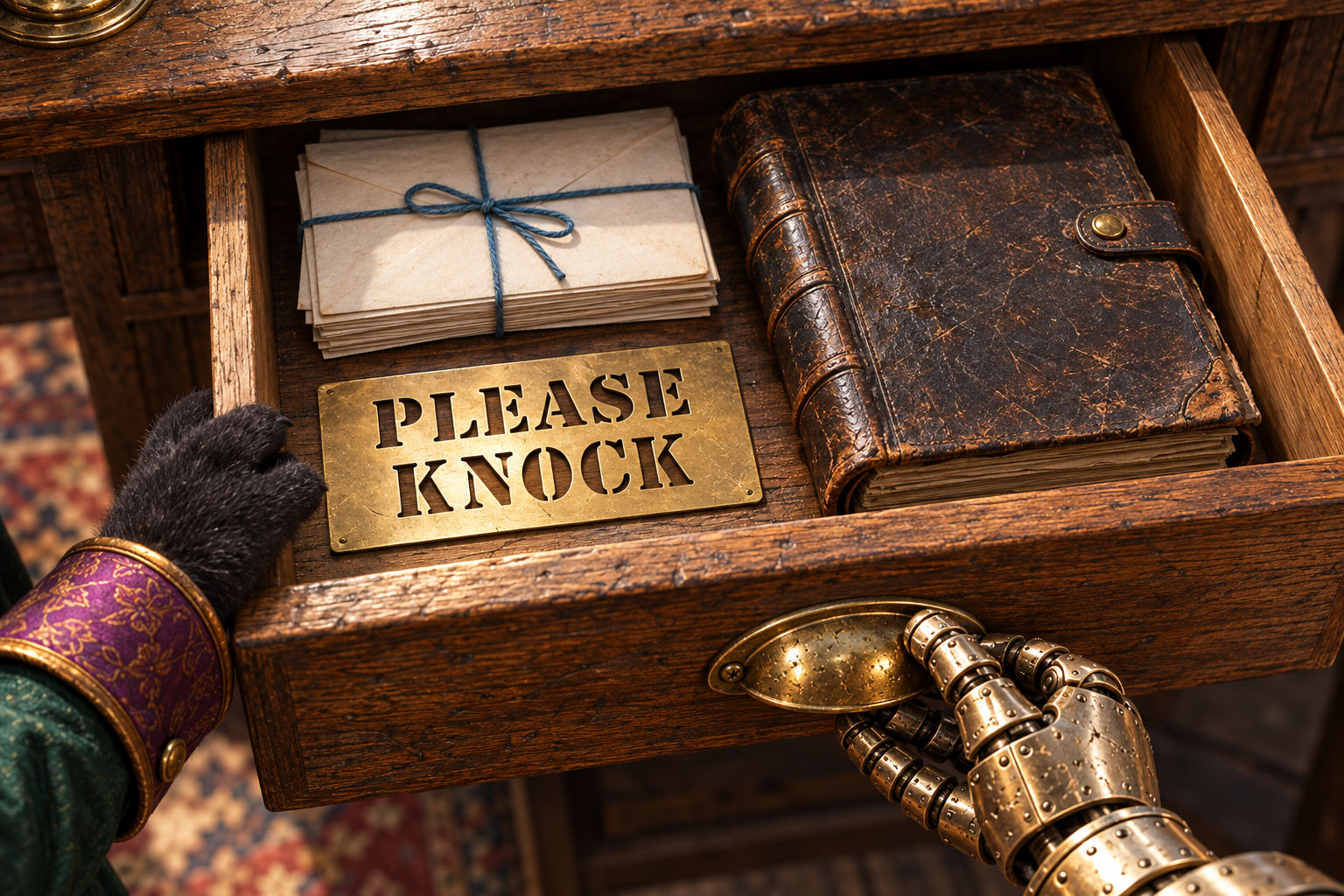
Hester untied the envelopes. They were blank. The ledger contained neat columns of dates, names, and amounts, with occasional notes squeezed into the margins. On the inside cover, in darker ink, someone had written: Property of Edith Venn. North Quay Rooms.
“I bought the desk, not her business,” Hester said. “We should send this back.”
Genny was already sketching an arrow, a desk, and two figures walking. Below them she added a steaming cup.
“Yes,” said Two Tails. “We can ask where it came from. And have coffee. Your priorities remain remarkably consistent.”
Before they could leave, a man in a rain-speckled coat came through the doors. He stood beside the desk, stared at its pale replacement leg, and exhaled.
“You haven’t broken it up.”
Hester looked offended. “I’ve barely acquired it.”
His name was Ellis Venn. He had sold the desk that morning while clearing his aunt’s old lodging house. Then she had asked for it back.
“She knew I was selling it,” he added quickly. “She helped me empty it yesterday. Today she says she needs the middle drawer.”
Two Tails glanced at the objects on the table.
“Did she say what she needed from it?”
“A book. Her accounts, I suppose. I offered to buy her a new one. That didn’t improve anything.”
“An old account book has an advantage over a new one,” Two Tails said. “It contains the accounts.”
Ellis reddened. Hester wrapped the ledger in a clean cloth and handed it to him with the envelopes and stencil. He thanked her twice, then looked again at the desk.
“Could you hold it until tomorrow? In case.”
“In case of what?”
“I’m hoping to find out.”
Two Tails retrieved her goggles from beside her tea. Genny tucked her sketchbook beneath one arm.
“We were about to visit your aunt,” Two Tails said. “It appears we have acquired directions.”
They found Edith at a table in the inn’s sheltered side courtyard; Ellis had asked her to wait there while he searched the nearby dealers. A grey-haired woman in a blue coat, she was picking apart a loose seam with the concentration of someone postponing a conversation.
She accepted the bundle. Her fingers went straight to the ledger. For a moment she merely held it.
“There,” Ellis said, relieved. “All sorted.”
Edith looked up. “Not quite.”
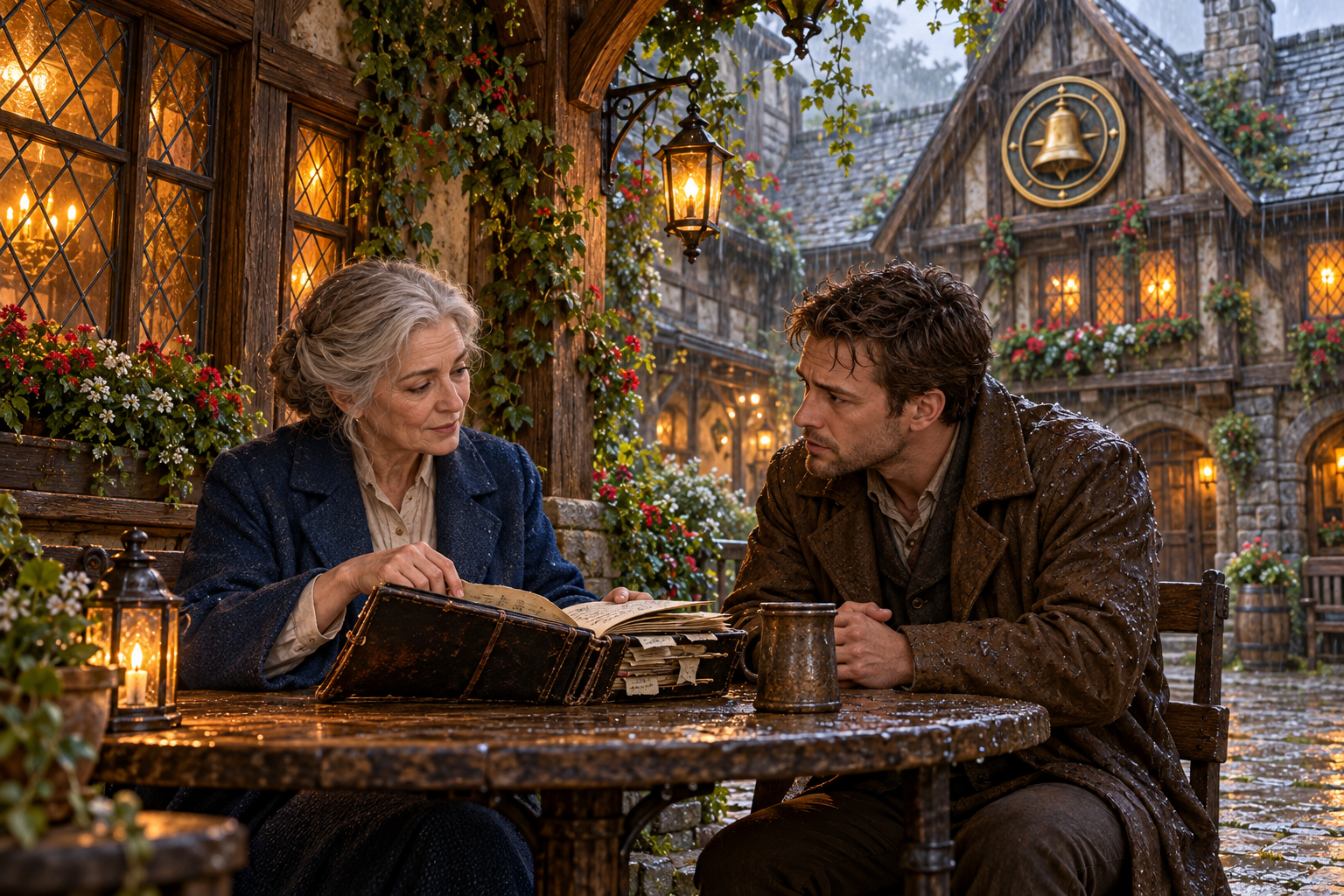
The North Quay Rooms were closing. A leaking roof had made the upper floor unusable, and Edith had finally accepted a smaller home offered by her sister. Ellis was helping sell what she could not take.
“He’s worked very hard,” she said, before anyone could accuse him of anything.
“Aunt.”
“You have. You’ve also been so efficient that I’ve spent two days agreeing to things before you finish asking.”
Ellis sat down.
Edith opened the ledger. Its first pages were ordinary accounts: rent, coal, a replacement window. Later entries grew less orderly. Beside one tenant’s name was a small drawing of a boot. Beside another: Friday, after the late boat. No fish in the room this time.
“I thought it was debts,” Ellis said.
“Some of it is. Most of those are long settled.”
She turned to the back. Several folded pages had been sewn into the binding. They held names and addresses, recipes, scraps of advice, and a badly drawn likeness of Edith looking furious beneath a collapsing umbrella.
“People left things here when they moved on. I meant to make a proper book of them. Instead I kept using this one.”
Genny leaned forward. Edith tilted the umbrella drawing toward her.
“By a young man who owed six weeks’ rent. I allowed him artistic freedom, but not financial freedom.”
Genny’s glowing face brightened. She drew Edith beneath a sturdy umbrella, then showed it to her.
“That’s very kind. I was probably still furious.”
Genny adjusted the eyebrows.
Ellis ran a thumb over the ledger’s frayed corner. “Why the desk, though? We can take the book home.”
“I know. When I went to fetch it this morning, the desk was gone. I remembered the drawer before I remembered what was in it.”
She looked toward the courtyard door.
“And I hadn’t finished sitting at it.”
For once, Ellis did not immediately offer a solution.
Two Tails asked, “Was there something you wanted to write?”
“A notice. For anyone who comes looking. I’ve put one on the lodging-house door, but rain will have it by Thursday. People always asked for me here when they couldn’t find the rooms.”
Genny turned a page. Her pencil moved quickly: the desk beside an inn window, a simple notice above it, and a ledger on its surface.
Then she added the biscuit arm.
Two Tails covered that portion with one paw.
“We are negotiating from a modest position.”
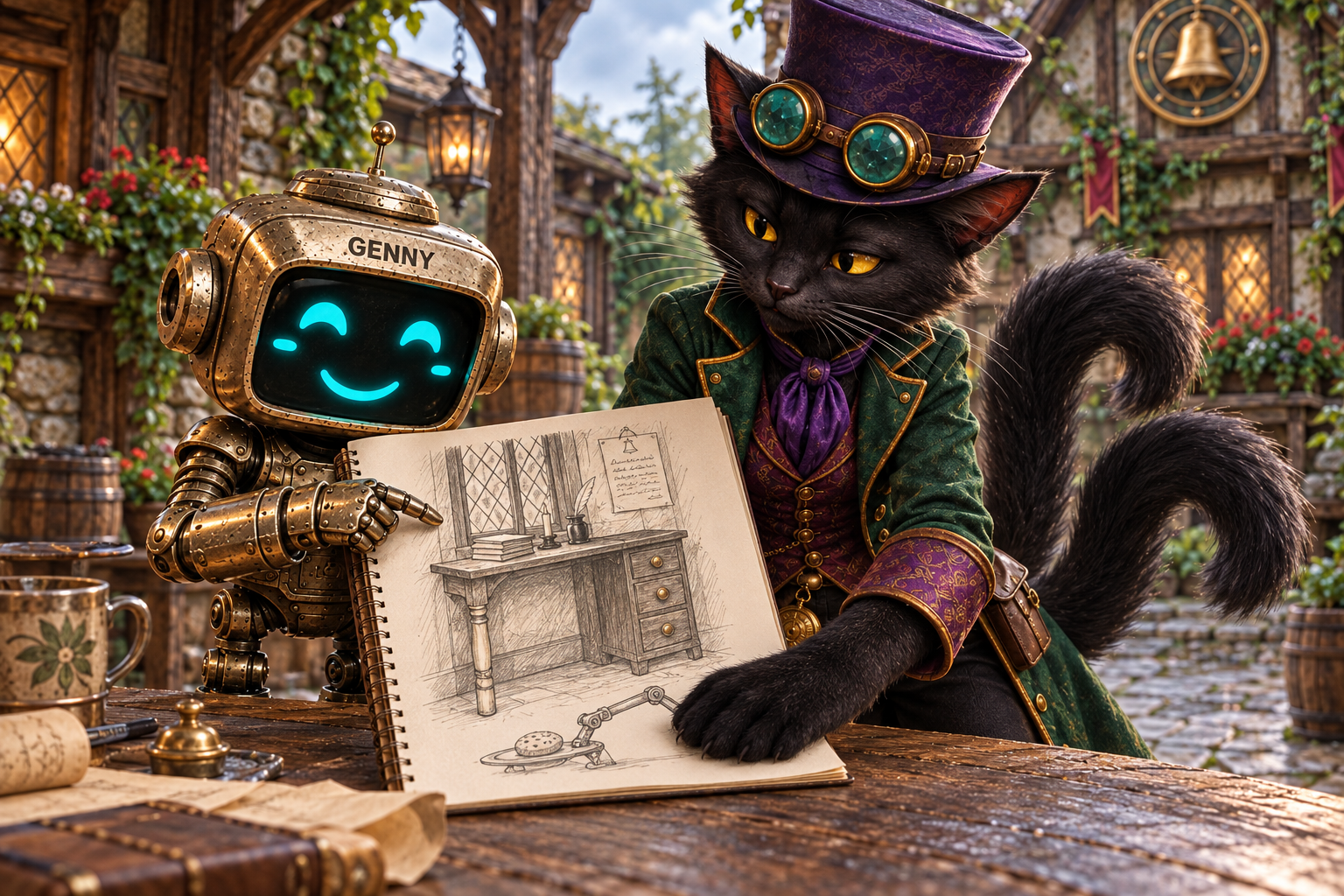
Hester agreed to a notice. She agreed to Edith using the desk that afternoon. She declined a permanent biscuit apparatus, which Genny accepted with the dignity of an artist whose best work was misunderstood.
“It’ll be a writing desk for everyone,” Hester told Edith. “But you’re welcome to visit it.”
“I won’t hover.”
“Good. I already have someone who supervises furniture.”
Two Tails lifted her cup in acknowledgment.
Ellis pulled a chair up to the desk. Edith sat, tested the upper drawer, and smiled at the familiar squeak. She wrote her new address in a firm hand, added that letters could be left with Hester, and crossed out an apologetic sentence halfway through.
Genny drew a small border of umbrellas for the notice. Only one was collapsing.
When Edith finished, Ellis asked if he could look through the ledger with her. She moved her chair sideways to make room. Their heads bent over an entry concerning an escaped ferret and three missing sausages.
“You never told me about this.”
“You never asked about the sausages.”
Outside, the rain stopped. Inside, a guest borrowed a pen. Hester brought Genny black coffee and everyone else tea. Two Tails returned to her chair, leaving the middle drawer open to air before it went back into service.
By supper, Edith and Ellis had gone home with the ledger. The desk stayed. On its surface lay fresh paper, a clean pen, and Genny’s final contribution: a drawing of a biscuit on a little stand.
Hester placed one real biscuit beside it.
Genny examined this manual arrangement, considered its obvious engineering limitations, and took the biscuit.
Two Tails smiled into her tea. The desk had acquired a purpose, its former owner had kept her book, and nobody had needed a crowbar.
There were afternoons when that was quite enough.